
Disclaimer: The images in this article are AI-generated via Midjourney and should not be taken as proof or realism.
I’ve always been captivated by that first photo of Earth from space – you know, the “Blue Marble” shot from Apollo 17. It’s beautiful, iconic, and, according to many people, completely fake.
While most of us learned about Earth’s spherical shape in elementary school, we live in an era where this ancient debate has roared back to life. YouTube channels dedicated to Flat Earth rack up millions of views, celebrities tweet their doubts about Earth’s curvature, and international conferences draw thousands of attendees.
The modern Flat Earth movement really took off around 2015, but its roots dig surprisingly deep.
But why are we still talking about this in an age when anyone can watch live feeds from the International Space Station? Why do some people look at GPS technology, satellite TV, and photos from space and say, “Nope, not buying it”? Why does the Flat Earth Society, founded in the 1950s, now boast more members than ever?
We’ve obviously got a lot of ground to cover here (flat or curved, you decide 😉), so let’s dive into the fascinating world of modern Flat Earth theory.
Modern Flat Earth theory is surprisingly complex, with different schools of thought that would make even Bigfoot hunters blush at their simplicity.
The most common model, often called the “Disk Model,” pictures Earth as a massive circular disk, kind of like a vinyl record.
The North Pole sits right in the center, while Antarctica isn’t actually a continent – it’s a massive ice wall about 150 feet high that rings the entire disk’s edge, holding in all our oceans like nature’s biggest swimming pool.
Above us? Well, that’s where things get even more interesting.
Most Flat Earthers believe in something called “the dome” or “the firmament,” a giant solid barrier arching over our disk world like a cosmic snow globe. The sun and moon are described as spotlights, each about 32 miles wide, circling above us in a regular pattern.
Stars? They’re either lights embedded in the dome or holes letting in light from… whatever’s beyond.
But here’s where modern Flat Earth beliefs take a wild turn from their historical roots:
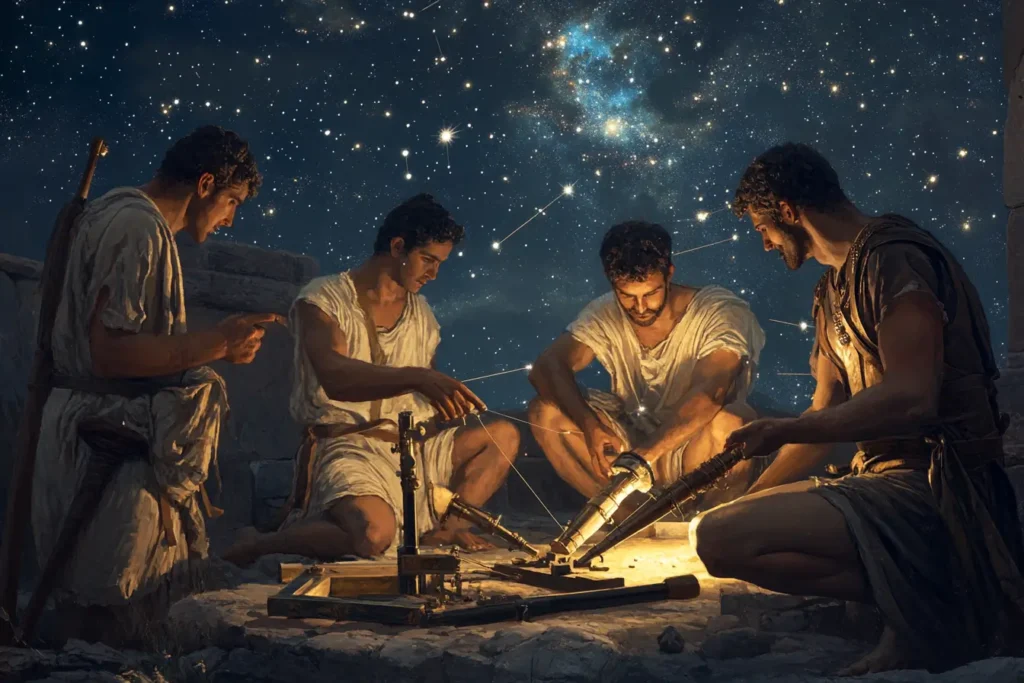
Before we dive into modern flat Earth drama, let’s take a quick trip back in time – and I mean way back. We’re talking ancient civilizations who had some pretty wild ideas about what they were standing on.
After all, who could say otherwise? They had no satellites or technology, and could only walk or sail around, and would have in no way felt any sort of curvature.
So, picture this. It’s 6th century BC Babylonia, and you’re looking at the oldest known world map. What do you see? A flat disc floating in an endless ocean.
The ancient Egyptians? Same idea. They called Earth the “House of Geb,” although even back then there were people who argued its credibility, such as Eratosthenes, who claimed to figure out the Earth was round after experimenting with shadows.
The early Israelites? They one-upped everyone by adding a solid dome sky with stars stuck to it like cosmic refrigerator magnets.
Even the ancient Greeks, who gave us democracy and Olympic sports, couldn’t quite agree on Earth’s shape.
While we often hear about their later spherical Earth theories, many of their heavy hitters started out as flat-Earthers. Thales, often called the first philosopher, thought Earth was just chilling in the ocean like a giant log.
Anaximenes, an Ancient Greek philosopher, figured Earth was flat and “riding on air” (ancient hoverboard, anyone?).
Meanwhile, in ancient China, scholars were absolutely convinced that the Earth was flat and square, with round heavens above – and they stuck to this idea until European missionaries showed up in the 17th century with some different thoughts.
But here’s where things get interesting, because someone decided to actually test these theories…
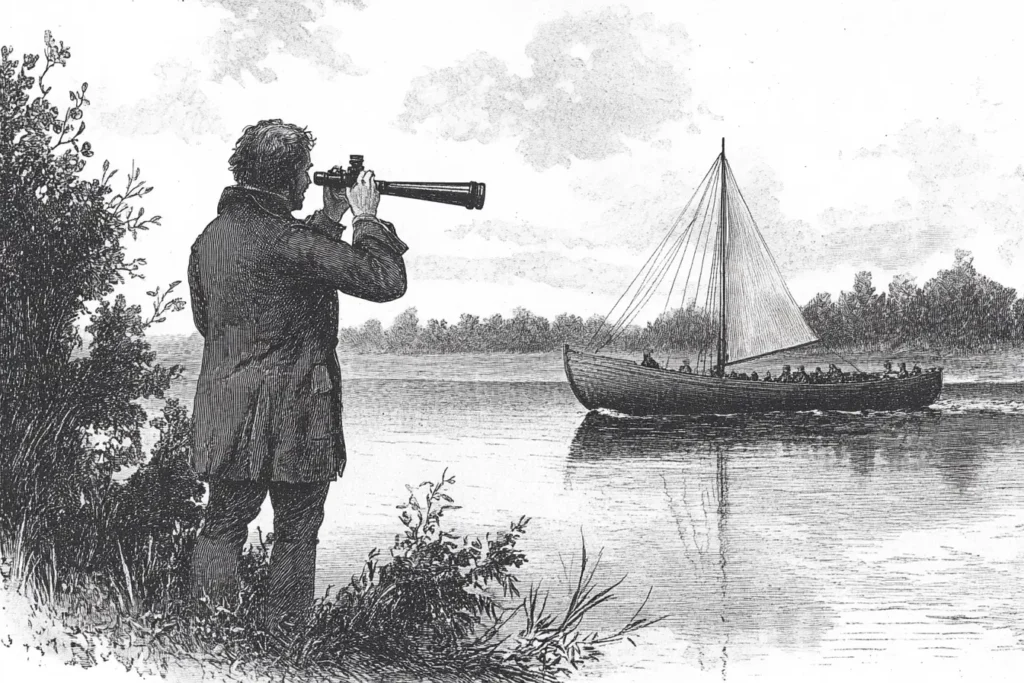
It’s a warm summer day in 1838, and Samuel Birley Rowbotham is wading into the Old Bedford River in England. Armed with a telescope held just 8 inches above the water, he’s about to conduct an experiment that flat Earth believers still talk about today.
Rowbotham watched a boat with a 5-foot mast row away from him.
According to his calculations, if the Earth were a globe, that mast should have disappeared from view after about 6 miles, dropping about 11 feet below his line of sight due to the curve of the Earth.
But through his telescope, he claimed to see the boat clear as day for the entire journey to Welney Bridge.
This experiment caught fire in 1870 when a supporter named John Hampden got so confident about it that he wagered money on the results.
Enter Alfred Russel Wallace, a serious naturalist and surveyor who took up the challenge. While Wallace won the bet, things got messy fast.
Hampden accused him of cheating, lawsuits flew back and forth, and eventually Hampden landed in jail for libel – though interestingly, the court did suggest Wallace hadn’t played entirely fair.
But wait, it gets better.
In 1904, Lady Anne Blount decided to put her own spin on the experiment. She hired a professional photographer named Edgar Clifton to take photos of a white sheet placed at Rowbotham’s original position, viewed from 6 miles away.
Clifton, using a camera mounted just 2 feet above the water, was shocked to capture clear images of the sheet – something that should have been impossible if the Earth were curved.
The photos spread like wildfire again, and while skeptics muttered about atmospheric refraction and possible collaboration between Blount and Clifton, a mystery still hangs over them.
However, with world wars raging and humanity focusing on other things, the movement seemed to die down a little until it was revived by Samuel Shenton in 1956, when the Flat Earth Society was founded.
But the movement kept a bit of a low profile until the rise of social media and content as we know somewhat exploded around when the YouTube algorithm seemed to take a liking for Flat Earth content.
This explosion of people taking an interest in the theory, even if they thought it was just funny or curious, created an explosion of creators, and thus more followers to the cause.
This was later amplified again by the release of the 2019 Netflix documentary “Behind the Curve” going viral.
These days, Flat Earth communities have evolved way beyond just questioning Earth’s shape. Many believers weave together a complex tapestry of interconnected theories involving:
Let’s have a look at them now.

So there are a lot of theories and content out there. A lot of people are saying this experiment happened, and this idea has been debunked, but what’s actually going on? What do the theories say?
How is the Flat Earth concept actually formed at the moment, and what do the Flat Earth researchers say?
Let’s start with the dome idea – the most popular theory.
This, as above, is the idea that we’re living under a cosmic dome that covers the disk that is Flat Earth. A dome is known as “the firmament.” Think of it like we’re living in the world’s biggest snow globe, minus the fake snow and tiny plastic trees.
Flat Earth researchers point to ancient texts that describe a “firmament” separating the waters above from the waters below. They argue that the blue sky we see is actually the reflection of our oceans on this dome’s interior surface.
That’s pretty creative if nothing else, but the idea actually dates back as far as early Hebrew cosmology.
But what about stars and planets?
According to this theory, they’re either sophisticated projections onto the dome or small lights moving in predetermined patterns. When asked about the countless photos of planets from telescopes? “Advanced holograms,” they’ll tell you.
Or maybe… it’s all about Antarctica?
A huge number of Flat Earth believers say Antarctica isn’t a continent at all – it’s actually a 150-foot-high ice wall that circles the entire disk of Earth, holding in all our oceans like nature’s biggest bathtub.
Why can’t we just go check?
Well, that’s where the conspiracy deepens.
Believers point to the Antarctic Treaty of 1959, which they say isn’t actually about protecting the environment – it’s allegedly about keeping people away from the ice wall.
Some researchers even suggest that’s why no one is allowed to freely explore Antarctica (though this isn’t actually true – you can book a tourist trip right now). They believe armed guards patrol the ice wall to prevent anyone from discovering what’s really beyond.
Wait, what about space travel?
This is where modern Flat Earth theory gets really interesting. Most believers don’t just think the Earth is flat – they think the entire space program is an elaborate hoax.
NASA’s $22.5 billion annual budget? “It’s all going to CGI and special effects,” they’ll tell you. The International Space Station? “A Hollywood set.” Those SpaceX rocket launches we can watch with our own eyes?
“High-altitude planes with clever camera tricks.”
The theory suggests that every space agency in the world – NASA, ESA, Roscosmos, and even private companies like SpaceX – are all in on it.
That’s dozens of countries and thousands of employees all keeping the same secret.
When you point out that some of these countries are historical enemies, believers have an answer: “The space race was just theater to make it all seem real.”
But what about all the evidence? Well, while these theories might sound outlandish to most people, Flat Earth believers have actually developed some surprisingly complex explanations for everyday phenomena we take for granted.

Just like any good investigation, we need to look at both sides – what Flat Earth researchers present as proof and what scientists say in response.
One of the most common pieces of “evidence” Flat Earth believers point to is the horizon itself. “If the Earth was a ball 25,000 miles in circumference,” they argue, “you should see a clear curve.”
They often conduct experiments using spirit levels, lasers, or zoom cameras to show that the horizon appears perfectly flat. Some even take these tools onto planes, though most airlines politely request that you don’t wave laser pointers around at 35,000 feet.
Scientists respond that the Earth is simply too big to see the curve from ground level – you need to be at least 35,000 feet up to start noticing it. They compare it to standing on a basketball court; from your perspective, that looks flat, too.
Perhaps the biggest piece of modern “evidence” involves analyzing NASA photos. Flat Earth researchers spend countless hours examining space photos and footage, looking for inconsistencies.
They point to things like:
Of course, NASA has explanations for all of these.
The identical clouds?
Different angles of the same weather system.
No stars in moon photos?
The camera exposure was set for the bright lunar surface.
Those bubbles?
Ice particles reflecting sunlight.
Remember that ice wall we talked about? Flat Earth researchers point out that no one has ever crossed Antarctica solo, on foot, without resupply.
Well, except for Colin O’Brady, who did exactly that in 2018. But that just added more fuel to the debate, with some believers suggesting he was either part of the conspiracy or didn’t actually cross where he claimed.
While we’ve been focusing on Flat Earth evidence, humans have actually known Earth was round since at least 240 BCE, when Eratosthenes measured its circumference using shadows in different cities.
Modern science has countless proofs:
But perhaps the most compelling argument? Every other planet and moon we can observe is spherical. Flat Earth believers would need to explain why Earth alone breaks this universal pattern.

After diving deep into the world of Flat Earth theory, you might be expecting a clear verdict – a decisive “here’s why they’re wrong” conclusion. But I think there’s something more interesting going on here.
Look, I’ll be direct: all available scientific evidence points to Earth being a spheroid. We can measure it, photograph it, and literally fly around it. But that’s not really what makes the Flat Earth phenomenon fascinating.
The real question is: why do these beliefs persist and even thrive in our modern age? Why do intelligent, often well-educated people spend countless hours developing increasingly complex theories about disk worlds and cosmic domes?
I think it taps into something fundamentally human – our desire to question, to investigate, to not take things at face value. In a world where we’re told to “trust the experts” and “follow the science,” Flat Earth believers are doing something radical: they’re demanding to see proof with their own eyes.
And you know what? That’s actually a pretty scientific attitude, even if their conclusions don’t align with established science.
Think about it: Flat Earth researchers:
Sound familiar? That’s basically the scientific method.
The irony is that by trying to disprove science, many Flat Earth believers end up engaging in science – real, hands-on, experimental science. Some have even accidentally proven Earth’s curvature while trying to disprove it (looking at you, Netflix documentary “Behind the Curve” 😉).
Whether you’re a die-hard globe believer or currently shopping for spirit levels and laser pointers, I think there’s value in keeping an open mind – not necessarily about Earth’s shape, but about why people believe what they believe.
In a world increasingly divided by what we believe to be true, maybe understanding the Flat Earth community can teach us something about bridging these divides. After all, if we can have civil discussions about the very shape of our world, maybe there’s hope for all those other topics that split us apart.
For those intrigued by this topic, there’s plenty more to explore. Scientific organizations regularly offer public viewing nights at observatories. You can track the ISS passing overhead with your own eyes. You can even book a trip to Antarctica (ice wall patrol permitting 😄).
Just remember: questioning is good. Investigation is good. But maybe, just maybe, sometimes the simple answer – that we’re all spinning through space on a beautiful blue marble – is actually the right one.
